By: Duane Craig
Colorado’s watershed continues being poisoned by the state’s mining legacy, according to this article. Abandoned mines so far have impaired 1,300 miles of the state’s streams and the headwaters of 40 percent of the Western rivers.
The toxic sludge flowing from just one of the more notoriously contaminating mines, the Penn Mine, released “186 pounds of cadmium, 4,496 pounds of copper, 21,529 pounds of manganese, 21 pounds of lead and 39,896 pounds of zinc in a single year.” That contamination left two waterways largely devoid of aquatic life. The solutions are complex and challenging, and whatever ones are chosen it will still be decades before the natural world and water supplies can begin to recover. Read the entire, in-depth story at the link above.

Water Contamination, Land Pollution & Hazardous Waste Material are issues families all across America are afflicted with daily.
Showing posts with label mines. Show all posts
Showing posts with label mines. Show all posts
Monday, October 1, 2012


Thursday, February 16, 2012
Survivors on a Radioactive Wasteland
By: Duane Craig
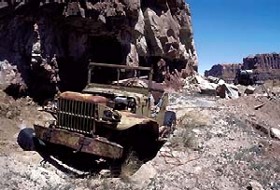
There is a long story of radioactive
contamination across New Mexico, especially in the northwestern portion of the
state, where recent estimates of cleaning up just one site will require the
removal of 1.4 million tons of soil, according to an article at E&E
Publishing, LLC.
Much of this story centers around the
U.S. Department of Energy and the United States’ race with the Soviet Union to
see who could create more nuclear weapons. The five-year cleanup plans in this
part of the country come and go like the winds, while more than 500 polluted
mine sites wait to be cleaned up. Meanwhile, the people live with contaminated
water and land, and there are even radioactive homes that were built with waste
from uranium mining.
The Environmental Protection Agency says
miners took about four million tons of uranium from Navajo lands between 1944
and 1986, and besides fueling the manufacture of nuclear bombs, it was also
pressed into service for nuclear power plants. Uranium mining activity left an
indelible mark on the land and even in the water. In a part of the country
where 30 percent of residents use untreated water, and water quality is often
unknown or too dangerous to drink, the long-term health implications become
even more staggering.
There is much more to the detailed story here.
Subscribe to:
Posts (Atom)