By: Nathan Lamb
A New Hampshire town is seeking relief from a mysterious contaminant that has shut down local wells for more than a year, according to this story from the Eagle Tribune.
The Town of Atkinson is eying a $3 million plan to extend water service to a cluster of 34 homes that have been without drinking water since 2011.
The wells are contaminated with 1,4-Diozane, a probable carcinogen that can also cause liver and kidney damage. According to the Environmental Protection Agency (EPA), 1,4-Diozane is a synthetic industrial chemical that can quickly migrate through soil and groundwater. The chemical is widely used for industrial processes, and can be found in paint strippers, dyes, greases, varnishes and waxes.
The New Hampshire Department of Environmental Sciences (DES) is still seeking the source of the contamination, which so far has been restricted to a residential area off Emery and Belknap drives.
The DES—which currently provides residents with bottled water—announced that it will contribute up to $2 million to run water lines to effected homes. Town officials are mulling options to cover additional costs.
Located roughly 40 miles south east of Concord, New Hampshire, Atkinson has a population of approximately 6,100.

Water Contamination, Land Pollution & Hazardous Waste Material are issues families all across America are afflicted with daily.
Showing posts with label new hampshire. Show all posts
Showing posts with label new hampshire. Show all posts
Friday, May 24, 2013


Friday, March 29, 2013
Highway Garage Linked to New York Water Problems
By: Nathan Lamb
The State of New York is considering several fixes for contaminated wells near a highway maintenance garage in the town of East Fishkill, according to this story from the Poughkeepsie Journal.
The problem of unsafe levels of sodium and chloride in groundwater near the garage was discovered in 1995, and the state has funded bottled water and testing for some of the garage neighbors since then.
The State Department of Transportation (DOT) has released a draft proposal that outlined several possible fixes, including installing new wells for seven of the neighbors, relocating the garage's salt storage facility, or installing a reserve-osmosis system to treat the water. Adding new well fields was another possibility.
DOT representatives held a special meeting to outline those measures for the residents and get feedback.
Road salt has been a concern for environmental officials in recent years due to its impact on aquatic life and drinking water. A report from the New Hampshire Department of Environmental Services cautions that chloride is toxic to aquatic life and impacts vegetation—adding it’s completely soluble, very mobile and there’s no natural process that removes it from the environment.
That same report says sodium can be a problematic drinking water contaminant for people on low-sodium diets.
East Fishkill is a town of roughly 29,000 people, approximately 70 miles north of New York City.
Thursday, December 15, 2011
New Hampshire Town Struggles With Legacy Landfill
By: Duane Craig
 A necessity of a consumer-driven economic system is dumps, or as they are now called, landfills. In more environmentally-unenlightened times stuff was just taken out to a rural area and dropped off. When dumps came into vogue they were situated on land that had natural hollows where the debris could be dumped.
Eventually, people started noticing odors and wild animal populations increasing so dumps were turned into landfills with every day's deposits being covered up before nightfall. Municipalities started owning and managing landfills, much to their chagrin later, as in the case of the city of Dover, New Hampshire.
Dover has been grappling with what to do with its old landfill for 30 years and the story is a fascinating study in trying to find the right answer without having to spend too much. The problems began when water flowing below the sleeping landfill started to contaminate wells on its perimeter. Several years later the city figured it would go for Superfund status and have the federal government fund the cleanup. That was a bright spot until everybody found out the city was named one of the potentially responsible parties, or PRPs, and would have to cough up something toward the cleanup effort. There is much more to this story written in an easily understandable account at Foster's.com website.
Old landfills growing a problem
Eventually, people started noticing odors and wild animal populations increasing so dumps were turned into landfills with every day's deposits being covered up before nightfall. Municipalities started owning and managing landfills, much to their chagrin later, as in the case of the city of Dover, New Hampshire.
Dover has been grappling with what to do with its old landfill for 30 years and the story is a fascinating study in trying to find the right answer without having to spend too much. The problems began when water flowing below the sleeping landfill started to contaminate wells on its perimeter. Several years later the city figured it would go for Superfund status and have the federal government fund the cleanup. That was a bright spot until everybody found out the city was named one of the potentially responsible parties, or PRPs, and would have to cough up something toward the cleanup effort. There is much more to this story written in an easily understandable account at Foster's.com website.
Tuesday, December 13, 2011
Passing the Roadway Salt
By: Duane Craig
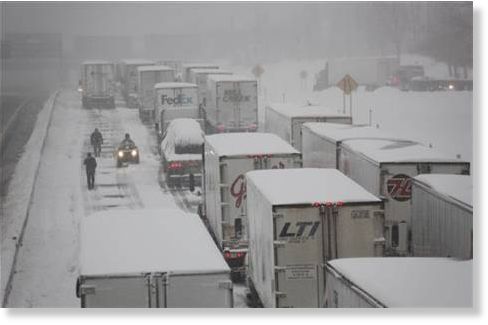 What happens to all the salt that's spread on roadways in northern climes to melt ice? Well, one place it appears to be ending up is in drinking water wells. Not only that, but the places where the salt is stored are also on the radar as potential groundwater contaminators, according to a report in the Watertown Daily Times.com.
In this case wells within a one mile radius of the salt barn will be tested. From Collins Landing to Seaway Avenue and beyond even perhaps to Grass Point State Park and Fishers Landing, the legacy of road maintenance extends well beyond the roads.
It was New York's neighbor to the east, New Hampshire, that first adopted a "general policy" of using salt on roadways. That year, the winter of 1941-42, about 5,000 tons of salt were used across the United States on wintry roads. However, as the highway system expanded, so did salt use until in 1970, 10 million tons were being used each winter, according to this paper.
Road salt contaminating groundwater
In Orleans, New York, residents and property owners are still waiting for the town's department of public works to coordinate water well testing with the state's department of transportation and it looks like the process of identifying the contaminated wells will be delayed another month. But, time probably won't make much difference at this point. According to one observer, contamination from the salt storage barn along I-81 first came to light in 2002 but salt has been used on roads for more than 60 years.In this case wells within a one mile radius of the salt barn will be tested. From Collins Landing to Seaway Avenue and beyond even perhaps to Grass Point State Park and Fishers Landing, the legacy of road maintenance extends well beyond the roads.
It was New York's neighbor to the east, New Hampshire, that first adopted a "general policy" of using salt on roadways. That year, the winter of 1941-42, about 5,000 tons of salt were used across the United States on wintry roads. However, as the highway system expanded, so did salt use until in 1970, 10 million tons were being used each winter, according to this paper.
Tuesday, August 10, 2010
NH Superfund Sites Living Long, Dirty Lives
August 9, 2010 - When many of us think of New Hampshire, we think of fresh-water lakes, clean mountain rivers and refreshing ocean waters.
But the state is also home to 20 Superfund sites that have caused water contamination problems from Berlin to Newington.
The Mottolo Superfund site in Raymond may be the only one currently causing residential well contamination, but all of the sites are still constantly monitored by the Environmental Protection Agency and/or the New Hampshire Department of Environmental Services, some more than 25 years after being added to the list of the nation's worst hazardous waste sites.
A site is named to the National Priority List if it reaches a certain score indicating high levels and large amounts of contamination hazardous to public health and the environment. There are 115 sites in New England and about 1,300 nationwide, according to Larry Brill, EPA chief of Superfund sites for the New England region.
It can take as long as 20 years to determine the best remedy for a site, and many are never deemed truly "clean."
More...
But the state is also home to 20 Superfund sites that have caused water contamination problems from Berlin to Newington.
The Mottolo Superfund site in Raymond may be the only one currently causing residential well contamination, but all of the sites are still constantly monitored by the Environmental Protection Agency and/or the New Hampshire Department of Environmental Services, some more than 25 years after being added to the list of the nation's worst hazardous waste sites.
A site is named to the National Priority List if it reaches a certain score indicating high levels and large amounts of contamination hazardous to public health and the environment. There are 115 sites in New England and about 1,300 nationwide, according to Larry Brill, EPA chief of Superfund sites for the New England region.
It can take as long as 20 years to determine the best remedy for a site, and many are never deemed truly "clean."
More...
Monday, December 14, 2009
New Hampshire couple's water contaminated with both arsenic and TCE
December 14, 2009 - Jason and Kelly Thomas worry every time they put their 15-month-old daughter in the bathtub. The Raymond couple brush their teeth with bottled water, cook with bottled water and think about what is in the water every time they wash the dishes or take a shower.
When they bought their 1700s home on Blueberry Hill in 2005, they knew there was a Superfund site across the street. What they did not know is that less than five years later, contaminants from that site would be leaking into their water supply.
More...
When they bought their 1700s home on Blueberry Hill in 2005, they knew there was a Superfund site across the street. What they did not know is that less than five years later, contaminants from that site would be leaking into their water supply.
More...
Wednesday, September 9, 2009
Drinking Water Found Contaminated in New Hampshire Neighborhood
September 9, 2009 - Five-gallon jugs of spring water were on nearly every doorstep of the Windmere housing development yesterday. The water is being delivered courtesy of the state due to drinking water contamination that may be linked to the nearby Mottolo Pig Farm Superfund site.
During recent testing on residential drinking wells, 10 showed levels of arsenic that exceed the recommended level for drinking water. Two others tested above the limit for TCE, trichloroethylene, an industrial solvent commonly used in dry cleaning.
More...
During recent testing on residential drinking wells, 10 showed levels of arsenic that exceed the recommended level for drinking water. Two others tested above the limit for TCE, trichloroethylene, an industrial solvent commonly used in dry cleaning.
More...
Friday, May 2, 2008
MtBE prevalent in Belknap County, New Hampshire private wells
April 20, 2008 - Private wells in Belknap County have a high rate of the gasoline additive methyl tertiary-butyl enter (MtBE), according to a recent study on MtBE prevalence in public and private wells in New Hampshire conducted by the United States Geological Survey.
The study, released earlier this year, revealed that, while MtBE has been banned in New Hampshire for more than a year, the chemical compound still lingers in low levels in public and private wells in the state.
The study revealed that MtBE well contamination is widespread, having been found in 18 percent of the public wells and nine percent of the private wells tested.
More . . .
The study, released earlier this year, revealed that, while MtBE has been banned in New Hampshire for more than a year, the chemical compound still lingers in low levels in public and private wells in the state.
The study revealed that MtBE well contamination is widespread, having been found in 18 percent of the public wells and nine percent of the private wells tested.
More . . .
Tuesday, April 1, 2008
No new conclusions in Liberty Hill, New Hampshire cancer report
March 26, 2008 - The report Gilford has been anticipating for the better part of the last year has finally been released and has added nothing new to what the state has already said about cancer concerns on Liberty Hill. However, what the report admits about potential exposure to past residents, visitors to the site and workers is what citizens have been concerned with all along.
More . . .
More . . .
Tuesday, March 4, 2008
Residents of Liberty Hill, New Hampshire are outraged
March 1, 2008 - With the N.H. Department of Environmental Services' decision just hours old, many who live on the Hill are left wide-eyed, shaking their heads about the state's decision to leave the vast majority of the estimated 121,000 tons of coal tar-contaminated material under the Gilford neighborhood forever.
"I don't even care about my property value any more. I have a five-year-old that I want to be able to grow up safely," said Richard Cote.
More . . .
"I don't even care about my property value any more. I have a five-year-old that I want to be able to grow up safely," said Richard Cote.
More . . .
Sunday, March 2, 2008
New Hampshire Department of Environmental Services visits contaminated neighborhood
February 22, 2008 - With snow covering the landscape, much like the barren waste underneath, Thursday's visit to Liberty Hill by New Hampshire Department of Environmental Services Commissioner Thomas Burack was more symbolic than substantive.
Responding to complaints from town officials about a perceived lack of action on the part of the state, Burack and his DES team made the journey to Gilford in order to get a better handle on the toxic waste resting under the Liberty Hill Road neighborhood.
More . . .
Responding to complaints from town officials about a perceived lack of action on the part of the state, Burack and his DES team made the journey to Gilford in order to get a better handle on the toxic waste resting under the Liberty Hill Road neighborhood.
More . . .
Sunday, January 20, 2008
Concerns over contaminated water intensify in New Hampshire
January 17, 2008 - A federal finding that drinking water at seven of 10 Rockingham County mobile home parks is contaminated with a gasoline additive called MTBE is surprising scientists and spurring ongoing legal efforts by the state to get oil companies to clean up the mess.
The study, released Jan. 1 in the journal Environmental Science & Technology, also found that half the private wells tested in the most populous regions of the county were similarly contaminated, as are 40 percent of the community water supplies in those areas.
More . . .
The study, released Jan. 1 in the journal Environmental Science & Technology, also found that half the private wells tested in the most populous regions of the county were similarly contaminated, as are 40 percent of the community water supplies in those areas.
More . . .
Tuesday, January 15, 2008
Coal tar contamination causing health worries among residents and officials in New Hampshire town
January 15, 2008 - Shortly after the Liberty Hill coal tar contamination was made public there were, residents and town officials have been raising concerns over health and environmental issues. The health fear is that the toxins underneath the Gilford neighborhood might be affecting area residents.
Now, three sisters are sharing their childhood story of Liberty Hill and their bouts with chronic illnesses. Robin Allard, Kim Bolton, and Allison Stresing sisters believe their health problems are linked to the coal tar that has been under Liberty Hill for the better part of six decades.
More . . .
Now, three sisters are sharing their childhood story of Liberty Hill and their bouts with chronic illnesses. Robin Allard, Kim Bolton, and Allison Stresing sisters believe their health problems are linked to the coal tar that has been under Liberty Hill for the better part of six decades.
More . . .
Thursday, January 10, 2008
State advises all New Hampshire residents to test wells for MTBE
January 5, 2008 - State officials are advising residents to have their private wells tested for MtBE, a chemical additive used in gasoline that has been linked to cancer in lab rats.
A new report shows the contaminant is widespread through the state.
A new report shows the contaminant is widespread through the state.
That the MtBE remains in wells a year after it was banned does not surprise New Hampshire Department of Environmental Service spokesman Fred McGarry.
"It will be that way for some time to come," said McGarry. "Exactly how long, we're still trying to figure out. Some experts feel it will take 20 to 30 years to dissipate, depending on the type of well or aquifer we're talking about."
Tuesday, January 8, 2008
Study: MTBE contamination rampant in New Hampshire
January 4, 2008 - A new study shows that contamination of New Hampshire's water supply by gasoline additive MTBE, a carcinogen that was banned at the start of last year, is widespread.
The study, conducted for the Department of Environmental Services by the U.S. Geological Survey, found MTBE, or methyl tertiary-butyl ether, in 18 percent of the 284 public wells tested statewide and in 9.1 percent of the 264 private wells tested.
More . . .
The study, conducted for the Department of Environmental Services by the U.S. Geological Survey, found MTBE, or methyl tertiary-butyl ether, in 18 percent of the 284 public wells tested statewide and in 9.1 percent of the 264 private wells tested.
More . . .
Tuesday, November 6, 2007
Consumers may foot the multi-million dollar cleanup bill for coal tar buried in Gilford New Hampshire
November 5, 2007 - Consumers may ultimately foot the multi-million dollar cleanup bill for coal tar buried in Gilford that originated at a manufactured gas plant in Laconia.
The New Hampshire Public Utilities Commission has authorized KeySpan Energy to recoup losses from ratepayers if efforts to get those costs from insurance carriers proves unsuccessful.
The dumping and its possible effects on residents' health which have been in the news for months, were described in a comprehensive and detailed report published in Sunday's Citizen.
More . . .
The New Hampshire Public Utilities Commission has authorized KeySpan Energy to recoup losses from ratepayers if efforts to get those costs from insurance carriers proves unsuccessful.
The dumping and its possible effects on residents' health which have been in the news for months, were described in a comprehensive and detailed report published in Sunday's Citizen.
More . . .
Monday, November 5, 2007
Residents of New Hampshire neighborhood still concerned about contamination and cancer despite assurances from state officials
November 4, 2007 - A refined government look at cancer cases among residents in the Liberty Hill Road area has determined there is no "cancer cluster" in the most recent 14-year period examined.
Residents still maintain, however, that there are a significant number of cancer cases among people living in the neighborhood, and they fear coal tar dumping in the 1950s may be to blame.
"Upon further review of more data, there is no indication of a 'cancer cluster' in Gilford, in the census blocks around Liberty Hill Road, or on lower Liberty Hill," reported Environmental Epidemiologist John Colby, who has prepared several cancer reports regarding potential links between the toxic coal tar material and cancer among residents on the hill.
A cancer cluster is defined by the U.S. Centers for Disease Control and Prevention as a greater-than-expected number of cancer cases that occur within a group of people, in a geographic area, or over a period of time.
However, according to experts who conducted the Gilford study, the findings do not rule out the possibility that a small isolated group of individuals could have been affected by the environmental hazard believed to have been buried there 55 years ago.
More . . .
Residents still maintain, however, that there are a significant number of cancer cases among people living in the neighborhood, and they fear coal tar dumping in the 1950s may be to blame.
"Upon further review of more data, there is no indication of a 'cancer cluster' in Gilford, in the census blocks around Liberty Hill Road, or on lower Liberty Hill," reported Environmental Epidemiologist John Colby, who has prepared several cancer reports regarding potential links between the toxic coal tar material and cancer among residents on the hill.
A cancer cluster is defined by the U.S. Centers for Disease Control and Prevention as a greater-than-expected number of cancer cases that occur within a group of people, in a geographic area, or over a period of time.
However, according to experts who conducted the Gilford study, the findings do not rule out the possibility that a small isolated group of individuals could have been affected by the environmental hazard believed to have been buried there 55 years ago.
More . . .
Tuesday, October 16, 2007
Gilford New Hampshire residents want all coal tar contamination removed from their neighborhood
October 10, 2007 - A coal tar dumpsite off Liberty Hill Road should be entirely cleaned up, in the view of area residents and other townspeople and local officials who attended an open forum on the issue.
The comments came in response to representatives of the state Department of Environmental Services who are recommending that most, but not all of the coal tar deposit that has existed in the area for more than 50 years be removed.
While members of DES have rejected the proposal by KeySpan Energy to contain 99.95 percent of the 121,000 tons of coal tar material in the ground of the Gilford neighborhood, citizens found the monetary rationale behind not mandating complete removal of the coal tar less than satisfactory.
More . . .
The comments came in response to representatives of the state Department of Environmental Services who are recommending that most, but not all of the coal tar deposit that has existed in the area for more than 50 years be removed.
While members of DES have rejected the proposal by KeySpan Energy to contain 99.95 percent of the 121,000 tons of coal tar material in the ground of the Gilford neighborhood, citizens found the monetary rationale behind not mandating complete removal of the coal tar less than satisfactory.
More . . .
Wednesday, June 13, 2007
New Hampshire residents shocked and dismayed by contamination near their homes
June 13, 2007 - Steven Silva stared at the N.H. Department of Transportation Bailey Bridge Yard directly across the street from his 1 Pasture Drive home.
The father of a 3-week-old baby girl, Silva said he was shocked and dismayed at the news of the massive lead paint dumping so close to the home he built only three years ago.
Although his was not one of eight families notified about the contamination, Silva said he needs to learn more about what lies so near his home. He is especially concerned about airborne particles and groundwater contamination.
More . . .
The father of a 3-week-old baby girl, Silva said he was shocked and dismayed at the news of the massive lead paint dumping so close to the home he built only three years ago.
Although his was not one of eight families notified about the contamination, Silva said he needs to learn more about what lies so near his home. He is especially concerned about airborne particles and groundwater contamination.
More . . .
Thursday, May 24, 2007
With focus on climate, funding to clean ground and water contamination dwindles
May 23, 2007 - “Certainly, clean air has taken a precedence over clean water,” said David Dedian, vice president of Woodard & Curran, the firm hired by state and federal authorities 25 years ago to take care of groundwater contamination at Keefe.
Keefe is part of Superfund, a federal program implemented to handle the worst-of-the-worst chemical spills in the country.
More . . .
Keefe is part of Superfund, a federal program implemented to handle the worst-of-the-worst chemical spills in the country.
More . . .
Subscribe to:
Posts (Atom)